Executive Summary
GLP-1 receptor agonists and newer dual- and triple-agonist agents have been adopted rapidly—roughly 1 in 5 Americans reports having used one—but 45%–65% of patients discontinue within the first year, most often citing cost and side effects. This brief reports on a recent national survey that found that starting and stopping GLP-1 drugs is associated with lower public trust in the pharmaceutical industry, especially with regard to pricing. This relationship is likely bidirectional: Quitting a costly drug—particularly when patients feel uninformed about costs and alternatives at initiation—may damage trust, and diminished trust may in turn reduce willingness to stay on medications. These findings suggest that lowering patient cost-sharing for GLP-1s could improve access, reduce discontinuation and help repair trust in the industry. Clearer provider communication about risks, benefits and out-of-pocket costs at the point of prescribing may set realistic expectations and blunt distrust.
Quitting GLP-1 Drugs Is Common, Raising Concerns About Trust
New drugs that treat obesity—glucagon-like peptide-1 (GLP-1) receptor agonists and newer dual- and triple-agonist agents—have the potential to revolutionize how we treat obesity. Recent surveys suggest that about 20% of Americans have used a GLP-1 for weight loss, diabetes or heart disease, reflecting rapid adoption of these medications.[1] But 45%–65% quit within the first year, citing high costs and side effects as the main reasons for discontinuation.[1,2] Concerns have been raised that negative experiences with medications impact trust in pharmaceutical companies and their products and pricing.[3]
Our National Survey Examined GLP-1 Use and Trust
In April and May 2026, we fielded a survey with 690 current users, 369 former users and 1,018 nonusers of GLP-1 drugs as part of the nationally representative Understanding America Study. Current and former users were over-sampled. We asked questions about trust in pharmaceutical companies to (1) develop effective drugs, (2) develop safe drugs, (3) disclose side effects, (4) act in patients’ best interest and (5) price products fairly. In this issue brief, we summarize our main findings from this survey and discuss the potential links between patient affordability, transparency in drug pricing and trust in pharmaceutical companies. The appendix provides details about the survey methods and analyses.
Former GLP-1 Users Expressed Low Trust
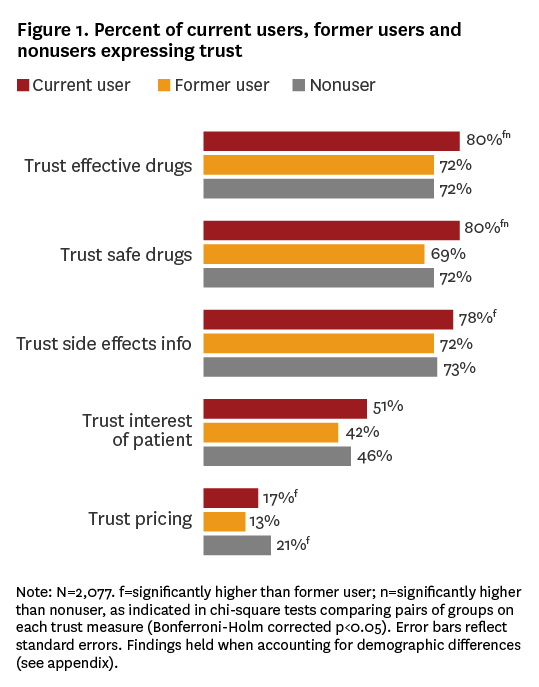
Former GLP-1 users expressed the lowest trust in pharmaceutical companies. Across the five trust questions, the average percent of current GLP-1 users expressing trust was 61%, but it was 57% for nonusers and 54% for former users. In particular, former GLP-1 users were less likely than current users to trust pharmaceutical companies regarding effective drug development (72% vs. 80%), safe drug development (69% vs. 80%), disclosure of side effects (73% vs. 78%), and trust in pricing (13% vs. 17%).
Trust in Drugs and Disclosures Was Much Higher Than Trust in Fair Pricing
A majority of current users, former users and nonusers expressed trust in drug development and disclosure of side effects. However, only 51% of current users, 42% of former users and 46% of nonusers trusted pharmaceutical companies to act in the best interest of patients. Moreover, trust was even lower in fair pricing: Former GLP-1 users reported the lowest level of trust in pricing practices (13%), followed by current users (17%) and nonusers (21%).
Quitting Can Lead to Low Trust, Which May Then Cause More Quitting
The findings reported here may reflect former GLP-1 users’ problems with covering the costs of GLP-1 medications, especially given the low trust in pricing. The causal effect may go both ways. First, having to quit a drug due to its high costs may damage trust in pharmaceutical companies, especially if the patient felt uninformed about costs and available options when starting a new drug. Low trust may then reduce patients’ willingness to take medications.
Implications for Drug Pricing and Providers
Previous reports have warned that Americans perceive profits to be a main driver of drug pricing, and that they trust the pharmaceutical industry less than other industries.[4,5] Our findings suggest that trust may be especially low among patients who start but then quit GLP-1 drugs, in part due to high costs.[1] Reducing patients’ cost-sharing for GLP-1 medications may allow more people to access treatment, decrease discontinuation rates, and repair trust in the pharmaceutical industry.
Providers sharing accessible information about the risks, benefits and costs of GLP-1 medication may further help improve transparency, set realistic expectations and reduce distrust.[6,7]
Supplemental information is available in the PDF version. This analysis was supported by the Schaeffer Center, which receives funding from foundations, government agencies, individuals, and corporations— including Amgen, Eli Lilly & Company and other companies that may have interests in obesity treatments.
References
- KFF. (2025). Poll: 1 in 8 Adults Say They Are Currently Taking a GLP-1 Drug for Weight Loss, Diabetes or Another Condition, Even as Half Say the Drugs Are Difficult to Afford. https://www.kff.org/public-opinion/poll-1-in-8-adults-say-they-are-currently-taking-a-glp-1-drug-for-weight-loss-diabetes-or-another-condition-even-as-half-say-the-drugs-are-difficult-to-afford.
- Rodriguez, P. J., V. Zhang, S. Gratzl et al. (2025). Discontinuation and Reinitiation of Dual-Labeled GLP-1 Receptor Agonists Among US Adults With Overweight or Obesity. JAMA Network Open, 8 (1): e2457349. https://doi.org/10.1001/jamanetworkopen.2024.57349.
- Brown, M. T., J. Bussell, S. Dutta, K. Davis, S. Strong and S. Mathew. (2016). Medication Adherence: Truth and Consequences. American Journal of the Medical Sciences, 351: 387–99. https://doi.org/10.1016/j.amjms.2016.01.010.
- Montero, A., G. Sparks, A. Kirzinger, I. Valdes and Liz Hamel. (2023). Health Tracking Poll July 2023: The Public’s Views of New Prescription Weight Loss Drugs and Prescription Drug Costs. KFF, August 4. https://www.kff.org/health-costs/kff-health-tracking-poll-july-2023-the-publics-views-of-new-prescription-weight-loss-drugs-and-prescription-drug-costs.
- Brenan, M. (2025). Computer, Restaurant Industries Lead U.S. Ratings. Gallup, September 25. https://news.gallup.com/poll/695555/farming-computer-restaurant-industries-lead-ratings.aspx.
Sine, S., and A. de Bruin. (2026). Patient Trust in Pharma Is Low; Here’s How to Rebuild It. Clinical Leader, February 2. https://www.clinicalleader.com/doc/patient-trust-in-pharma-is-low-here-s-how-to-rebuild-it-0001. - Way, D., H. Blazsin, R. Löfstedt and F. Bouder. (2017). Pharmaceutical Benefit-Risk Communication Tools: A Review of the Literature. Drug Safety, 40: 15–36. https://link.springer.com/article/10.1007/s40264-016-0466-1.