Voter turnout efforts should emphasize collective action, not despair
Low voter turnout is an ongoing threat to the health of U.S. democracy. More than one-third of eligible voters did not vote in the 2024 U.S. presidential election, and participation is usually even lower in midterm elections like the one approaching in November. In close elections, uneven turnout among candidates’ supporters can make all the difference.
Efforts to get out the vote often focus on demographic groups. Voting records show that young adults are less likely to vote than older adults, and that racial and ethnic minority citizens are less likely to vote than white citizens.
There may, of course, be many reasons why people don’t vote, but our new research shows that voter turnout is partly predicted by perceptions of what friends and family do.
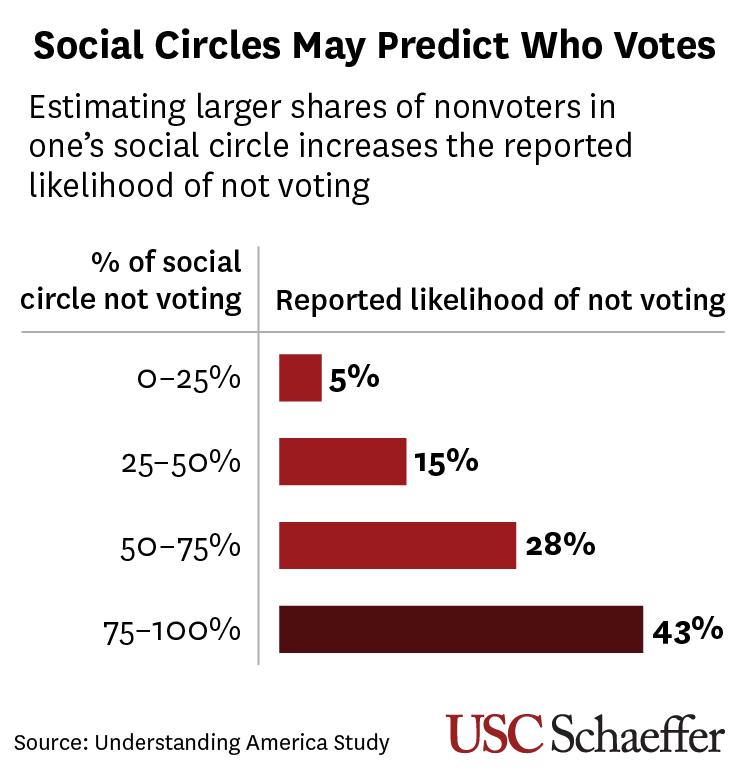
Our results are based on a survey with 3,621 participants of the Understanding America Study. Up to two weeks before the 2024 U.S. presidential election, they were asked about their own probability of voting in the election, as well as the percentage of their friends and family they thought would not be voting.
The chart below shows that people who estimated having more friends and family who would not vote were more likely to indicate that they would also refrain from voting in the 2024 presidential election. Those who estimated having 0-25% nonvoters in their social circle expressed on average a 5% chance that they themselves would not vote. By contrast, those who estimated that 75%-100% of their social circle were nonvoters expressed on average a 43% chance that they would sit out the election. People who had told us they did not intend to cast a ballot typically ended up reporting after the election that they did not vote.
We already knew that social circles predict how people vote, if they vote. In a Nature Human Behaviour study, we found that who Americans voted for in the 2016 presidential election was predicted by who they thought their friends and family would vote for. In fact, asking people who their social contacts will vote for predicts election outcomes better than asking people who they themselves will vote for.
It therefore makes sense that social circles also predict whether people intend to vote. These social influences may happen for different reasons. Friends and family may convince each other that voting does not matter, or they may just follow what they see others doing—or, in this case, not doing. People also like to surround themselves with others who are similar, so nonvoters may prefer the company of nonvoters, which then limits their exposure to others who may encourage them to vote.
So what does this mean for get-out-the-vote messaging? If it is demotivating to know a lot of nonvoters, then it may be important to make peers who do vote more visible. For example, a 2010 Election Day experiment involving 61 million Facebook users found that a one-time message showing pictures of friends who had clicked an “I voted” button increased people’s likelihood of voting by 0.39%, based on public voting records. Moreover, their close friends’ likelihood of voting increased by 0.22%. While these effects may seem small, they can add up in large populations: the Facebook experiment turned out roughly 340,000 voters who otherwise would have stayed home.
Highlighting voter participation can also help. Voter turnout messaging that emphasizes how many people vote appears to be more motivating than messaging that emphasizes how many people don’t vote, according to a widely cited field experiment. This is an important finding. While campaigners trying to rally support often emphasize the risk of low turnout, they are better off telling supporters: “A lot of people will be voting. Join in!”
📅 Webinar: Join us Sept. 15 for a discussion of these findings and other factors shaping voter intentions. Register here.
Wändi Bruine de Bruin is director of research with the Center for Civic Society at the USC Schaeffer Institute. Jose Scott is a postdoctoral researcher at the USC Schaeffer Institute.