
Summary
Long COVID remains a substantial public health challenge. Using nationally representative longitudinal data from the Understanding America Study, we estimate that by spring 2023 approximately 52 million U.S. adults had experienced at least one long COVID symptom, primarily affecting working-age adults. Among those affected, more than one-third experienced symptoms for over one year, and nearly 70% reported that their symptoms limited their usual daily activities. These estimates closely align with recent artificial intelligence-based studies using multiple sources of health data, indicating that independent approaches are converging on a similar estimate of the burden of long COVID. Together, these findings underscore the growing need for effective therapies and continued surveillance to address the long-term health and economic consequences of long COVID.
How Long COVID Prevalence Estimates Have Evolved
Since the emergence of COVID-19, researchers have sought to determine how frequently patients experience persistent symptoms following acute infection. Early studies published during 2020 and 2021 reported remarkably wide prevalence estimates, ranging from 0% to more than 93% of infected individuals.[1] Much of this variation reflected the rapid pace of research during the first years of the pandemic, when investigators relied primarily on hospitalized patients, specialty long COVID clinics and convenience samples before a standardized clinical definition of long COVID had been established.[2] These studies showed that persistent post-COVID illness was real but did not provide reliable estimates of population prevalence. A systematic review of 120 studies reported a pooled prevalence of 42.1% while also documenting substantial heterogeneity across study populations, outcome definitions and study designs.[1]
Between 2022 and 2024, study design became considerably more rigorous. Researchers increasingly relied on nationally representative surveys, prospective cohort studies, electronic health records (EHRs) and administrative claims. At the same time, the World Health Organization’s Delphi consensus and a chronic-condition framework from the Centers for Disease Control and Prevention (CDC) provided greater consistency in how long COVID was defined.[3,4] As measurement improved, estimates began to converge. Most large U.S. studies estimated that approximately 10% to 20% of infected individuals develop long COVID, while the CDC’s National Health Interview Survey found that 6.9% of U.S. adults had experienced long COVID and 3.4% were currently living with the condition in 2022.[5]
Despite this convergence, meaningful differences remained because studies continued to use varying case definitions and follow-up periods. Some studies relied on self-reported persistent symptoms, others on self-reported long COVID diagnoses, and still others on administrative diagnosis codes or clinical records. The UK’s Office for National Statistics has noted that these approaches identify affected populations and should not be interpreted as measuring the same underlying condition.[6] Estimates also depend on timing of assessment. Findings based on symptoms persisting three months after infection are not directly comparable with those measured after 12 or 24 months, as some individuals recover while others develop symptoms later in the disease course.[1,4]
These differences in case definitions have also prompted efforts to develop more accurate methods for identifying long COVID. Current evidence suggests that administrative diagnosis codes substantially underestimate disease burden because many patients with persistent post-COVID conditions never receive a formal long COVID diagnosis. In contrast, longitudinal cohort studies and validated EHR phenotyping algorithms consistently identify substantially more cases than diagnosis codes capture.[7–10] These approaches use AI and machine-learning models that integrate EHRs with patient survey and genomic data to identify probable long COVID cases that would otherwise go uncoded. AI-based approaches have also improved researchers’ ability to identify distinct long COVID subtypes and better understand the condition’s clinical heterogeneity, as well as predict which patients are at greatest risk of developing long COVID.[11–13] However, these methods remain largely dependent on information captured through the healthcare system, potentially missing less severe symptoms such as fatigue, headache, loss of smell and body aches that may not prompt patients to seek care.
Recent multisite U.S. studies using these methods estimate that approximately 1 in 6 infected patients develops long COVID, which is substantially higher than estimates based on diagnosis codes alone, and are consistent with findings from the Understanding America Study (UAS). Two independent approaches—AI-based EHR phenotyping and longitudinal population surveys—identify a similar overall burden of long COVID.
Why the UAS Improves Measurement
The UAS addresses many of the limitations of earlier long COVID studies by following the same nationally representative sample of U.S. adults over time.[14] Because respondents are surveyed before and after SARS-CoV-2 infection, the UAS can distinguish newly developed symptoms from symptoms already present before infection, which has been a key challenge in other prevalence studies. Repeated follow-up also allows researchers to track how symptoms evolve rather than relying on a single cross-sectional snapshot.
Earlier analyses of the UAS provided one of the first nationally representative longitudinal estimates of long COVID during the first year of the pandemic, between March 2020 and March 2021.[15] The analyses presented here extend that work through spring 2023, capturing the Delta and Omicron waves and providing updated estimates of both current and cumulative long COVID prevalence.
Study Methods
Our analysis includes 3,590 respondents who participated in waves 22 through 34 of the UAS COVID-19 Survey, spanning January 2021 through July 2023. Survey weights were applied to produce nationally representative estimates. We begin in January 2021 because, by that time, COVID-19 testing had become substantially more accessible than during the first year of the pandemic, improving identification of infections. This period also captures the largest U.S. waves of COVID-19 infection, including Delta and Omicron variants of the disease. July 2023 is the most recent survey wave with information on COVID-19 testing.
COVID-19 infection was defined as either a self-reported positive COVID-19 test or a report of a physician or other healthcare professional diagnosing the respondent. A respondent was classified as having a long COVID symptom if the symptom was absent in the survey wave immediately preceding infection and first appeared at least 12 weeks after infection. We focus on seven symptoms commonly associated with long COVID that were measured consistently across all survey waves. We estimate both current prevalence, which measures the share of respondents experiencing long COVID symptoms at a given point in time, and cumulative prevalence, which measures whether a respondent had ever developed a long COVID symptom during follow-up. Because the analysis requires sufficient pre- and post-infection observation periods to identify long COVID symptoms, the main results cover summer 2021 through spring 2023.
What We Found
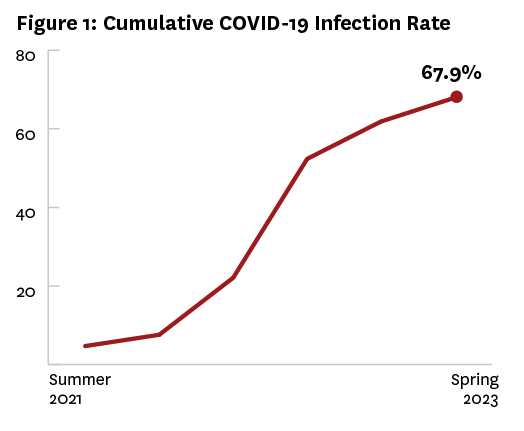
Our findings illustrate both the continuing burden of long COVID and the importance of distinguishing between current and cumulative prevalence. As successive waves of SARS-CoV-2 infection occurred, cumulative COVID-19 infections rose steadily to 67.9% through spring 2023 (Figure 1).
The prevalence of individual long COVID symptoms—including body aches, chest congestion, cough, fatigue, loss of sense or smell, shortness of breath, and sore throat—also increased over time (Figure 2a). Although point prevalence remained relatively modest for any single symptom. In spring 2023, 11.0% of respondents reported at least one of the seven long COVID symptoms.
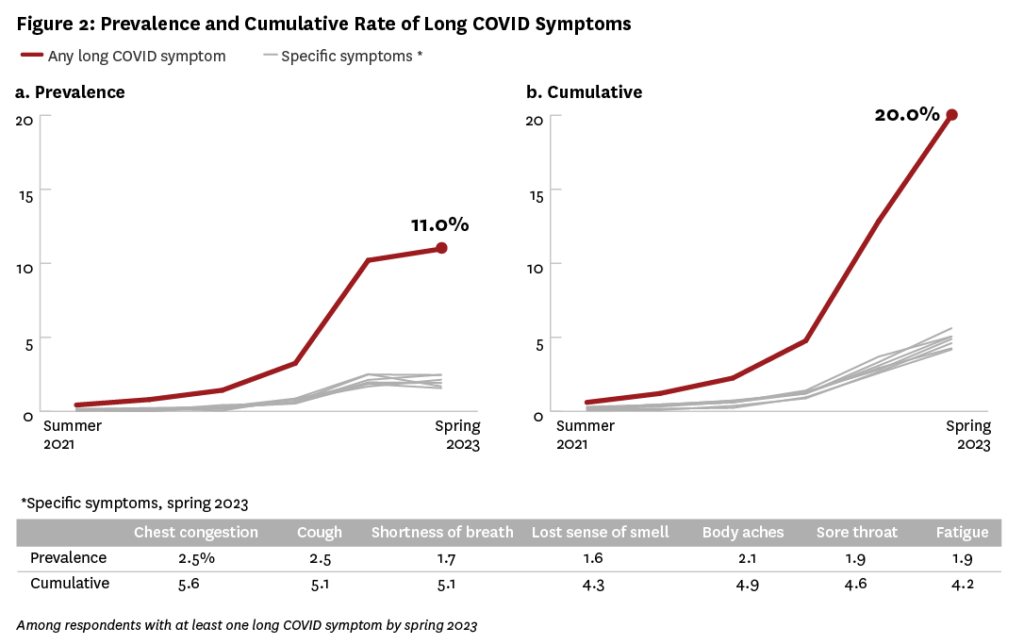
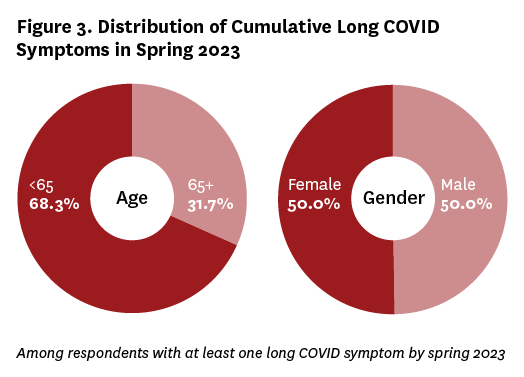
Looking at cumulative incidence provides a different perspective. By spring 2023, approximately 4.2% to 5.6% of respondents had experienced each of the major long COVID symptoms at some point following infection, and cumulatively, 20% experienced at least one of the seven symptoms (Figure 2b). Extrapolated to the U.S. adult population, these estimates imply that approximately 52 million U.S. adults had experienced at least one long COVID symptom by spring 2023. These findings indicate that the cumulative burden continued to grow even as the prevalence of current symptoms changed more gradually over time. Importantly, long COVID primarily affected people ages 18 to 64 (Figure 3). Nearly 70% of respondents who experienced at least one long COVID symptom by spring 2023 were under age 65, while the burden was distributed almost equally among women and men. Because most affected individuals were of working age, long COVID had important implications not only for healthcare utilization but also for labor force participation, productivity, disability and caregiving.
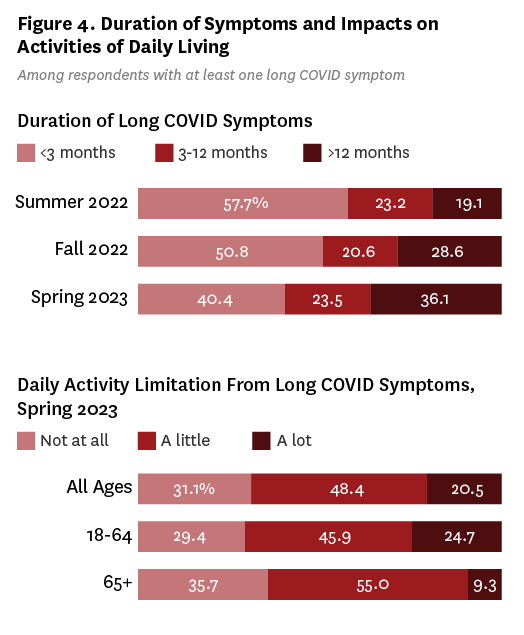
Additional analyses further illustrate the persistence of long COVID. Duration data underscores the chronic nature of the condition (Figure 4). By spring 2023, more than one-third of respondents with long COVID symptoms reported that their symptoms had persisted for more than 12 months, while an additional one-quarter had experienced symptoms for three to 12 months. Notably, the share reporting symptoms lasting more than 12 months nearly doubled, increasing from roughly 19% in summer 2022 to 36% in spring 2023. Long COVID also affected daily functioning. Approximately 1 in 5 respondents with long COVID reported that their symptoms limited daily activities “a lot,” while roughly half reported being limited “a little.” Limitations were more pronounced among ages 18–64: 1 in 4 reported being limited “a lot,” compared to less than 1 in 10 adults ages 65 and older. Applied nationally, these estimates suggest that roughly 10 million U.S. adults experienced severe limitations in their daily activities because of long COVID by spring 2023. These findings also suggest that even when symptoms are not completely disabling, they frequently interfere with work, school, caregiving and other routine activities.
Policy Implications
Long COVID’s prevalence should not be viewed as a single fixed number. Estimates depend on how the condition is defined, the population being studied, and whether researchers measure current or cumulative disease burden. However, the convergence of findings from the UAS and recent AI-based EHR studies suggests that modern measurement approaches are identifying a similar underlying burden of disease.
Our findings also underscore that long COVID remains an important public health and economic challenge even as the acute phase of the pandemic has subsided. As repeated COVID-19 infections continue to accumulate, so does the cumulative number of Americans who have experienced long COVID. While many individuals recover, a substantial share experience symptoms for a year or longer, and many report limitations in their daily activities. Our estimates suggest that approximately 52 million U.S. adults had experienced at least one long COVID symptom by spring 2023, with roughly 10 million reporting severe limitations in daily activities. These findings underscore that long COVID is not a rare complication but a chronic condition affecting millions of Americans.
The cumulative nature of long COVID also highlights the need for effective therapies. Unlike many acute infectious diseases, the burden of long COVID grows over time as additional infections lead to new cases while many existing patients experience persistent symptoms. Although some individuals recover, there are currently no Food and Drug Administration–approved treatments that target the underlying condition. Developing effective therapies that shorten symptom duration, improve functional recovery or prevent long COVID following acute infection could substantially reduce its long-term health and economic burdens.
The concentration of long COVID among working-age adults further amplifies these costs.[16] Persistent fatigue, cognitive impairment, respiratory symptoms and chronic pain can reduce labor force participation and productivity while increasing healthcare utilization, disability and caregiving needs. As a result, the burden of long COVID extends well beyond healthcare systems to employers, families and the broader economy.
Finally, these findings highlight the importance of continued surveillance. Many of the national datasets that have informed long COVID research—including COVID-specific surveys—ended in 2024 or are no longer collecting data. Yet long COVID has not disappeared. Continued data collection and longitudinal follow-up will be essential for understanding how prevalence changes over time, evaluating the long-term effects of repeated infections, monitoring recovery, and informing future healthcare planning and policy. Without ongoing surveillance, policymakers will have increasingly limited information about one of the pandemic’s most significant long-term health and economic consequences.
References
- Woodrow, M., C. Carey, N. Ziauddeen, R. Thomas, A. Akrami, V. Lutje, D. C. Greenwood and N. A. Alwan. (2023). Systematic Review of the Prevalence of Long COVID. Open Forum Infectious Diseases, 10 (7): ofad233.
- Huang, C., L. Huang, Y. Wang et al. (2021). 6-Month Consequences of COVID-19 in Patients Discharged From Hospital: A Cohort Study. Lancet, 397 (10270): 220–32.
- World Health Organization. (2021). A Clinical Case Definition of Post COVID-19 Condition by a Delphi Consensus. https://www.who.int/publications/i/item/WHO-2019-nCoV-Post_COVID-19_condition-Clinical_case_definition-2021.1.
- Centers for Disease Control and Prevention. (2026). Tracking Long COVID. https://www.cdc.gov/long-covid/php/surveillance/index.html.
- Adjaye-Gbewonyo, D., A. P. Vahratian, G. Cria and J. Bertolli. (2023). Long COVID in Adults: United States, 2022. NCHS Data Brief 480. https://www.cdc.gov/nchs/products/databriefs/db480.htm.
- Office for National Statistics. (2023). Self-Reported Long COVID Symptoms, UK: 10 July 2023. https://www.ons.gov.uk/peoplepopulationandcommunity/healthandsocialcare/
conditionsanddiseases/bulletins/selfreportedlongcovidsymptomsuk/10july2023. - Tian, J., A. Azhir, M. Decaro et al. (2026). Long COVID Persistence and Surveillance Gaps Across 58 US Hospitals. JAMA Network Open, 9 (5): e2614909.
- Guardo, C., Z. Xinmeng, S. Gangireddy et al. (2026). Multi-scale Data Improves Performance of Machine Learning Model for Long COVID Identification. Communications Medicine, 6 (1): 389.
- Strasser, Z. H., A. Dagliati, Z. Shakeri Hossein Abad et al. (2023). A Retrospective Cohort Analysis Leveraging Augmented Intelligence to Characterize Long COVID in the Electronic Health Record: A Precision Medicine Framework. PLOS Digital Health, 2 (7): e0000301.
- Azhir, A., J. Hügel, J. Tian et al. (2025). Precision Phenotyping for Curating Research Cohorts of Patients With Unexplained Post-acute Sequelae of COVID-19. Med, 6 (3): 100532.
- Zhang, H., C. Zang, Z. Xu et al. (2023). Data-Driven Identification of Post-acute SARS-CoV-2 Infection Subphenotypes. Nature Medicine, 29 (1): 226–35.
- Reese, J. T., H. Blau, E. Casiraghi et al. (2022). Generalisable Long COVID Subtypes: Findings From the NIH N3C and RECOVER Programmes. eBioMedicine, 87.
- Machado, R., R. Soorinarain Dodhy, A. Sehgal, K. Rattigan, A. Lalwani and D. Waynforth. (2024). A Machine Learning Approach to Identifying Risk Factors for Long COVID-19. Algorithms, 17 (11): 485.
- Alattar, L., M. Messel and D. Rogofsky. (2018). An Introduction to the Understanding America Study Internet Panel. Social Security Bulletin, 78 (2).
- Wu, Q., J. A. Ailshire and E. M. Crimmins. (2022). Long COVID and Symptom Trajectory in a Representative Sample of Americans in the First Year of the Pandemic. Scientific Reports, 12 (1): 11647.
- Kim. D. (2025). A Nationwide Study of Risk Factors for Long COVID and Its Economic and Mental Health Consequences in the United States. Communications Medicine, 5 (1): 104.


