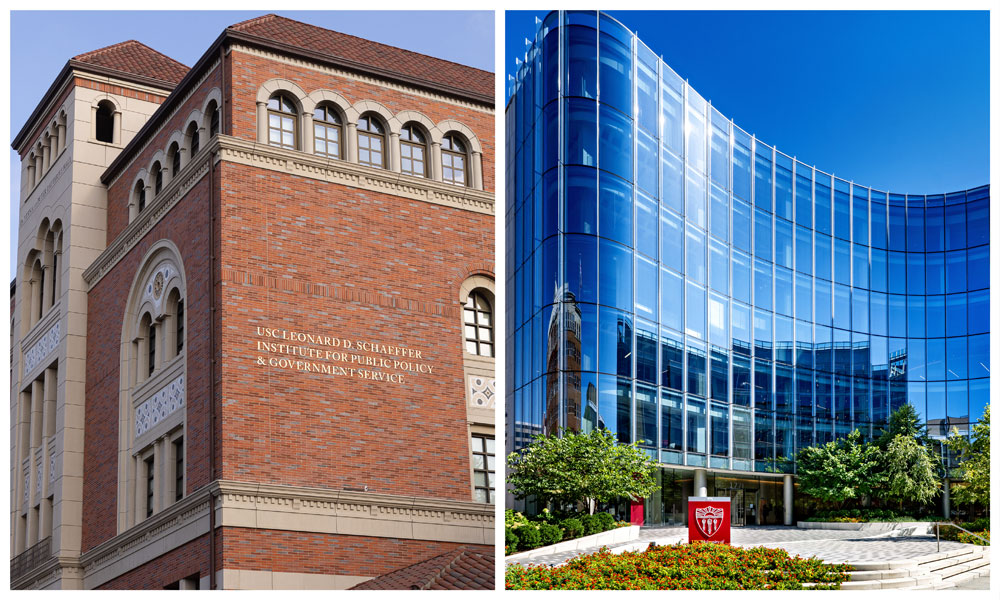
The move advances USC’s role as a hub for social science research and policy translation
The Center for Economic and Social Research (CESR) has joined the USC Schaeffer Institute for Public Policy & Government Service and the USC Price School of Public Policy, building on USC’s strengths in social science research and creating new opportunities to connect that work with public policy.
The integration combines CESR’s data capabilities with the Schaeffer Institute’s policy focus. It also extends the Institute’s work beyond its historic strengths in health policy to encompass a broader range of societal issues, linking data on individuals’ lived experiences with decisions at the local, state and federal level.
CESR is a leader in generating high-frequency, population-level data to better understand health, economic security and well-being in the United States and around the world. At the center of its work is the Understanding America Study (UAS), a nationally representative internet panel that assesses public attitudes on issues ranging from health and finances to behavior and daily life. This approach provides insights far more quickly than traditional surveys and administrative datasets.
“Under Arie Kapteyn’s leadership, CESR has set the standard for high-frequency research on how people experience and respond to change across their lifespan,” said USC Provost Andrew Guzman. “Its new home at the Schaeffer Institute builds on that record of excellence and strengthens USC’s ability to translate rigorous research into policy-relevant insight at scale.”
A pioneer in real-time social science research
As CESR joins the Schaeffer Institute, it will build on this foundation while continuing close collaboration with USC Dornsife College of Letters, Arts and Sciences faculty to advance high-impact, cross-university research. USC Price will also play an important role, administering CESR under the Schaeffer Institute umbrella and expanding the interdisciplinary reach of its scholarship.

“Our primary aim has always been to improve social welfare by informing decision-making in the public and private sectors,” said Kapteyn, who founded CESR in 2013 and is a Professor of Economics at USC Dornsife. “Joining the Schaeffer Institute marks an important next phase for CESR—expanding our ability to connect our research to policy and real-world impact.”
Since launching at the USC Dornsife more than a decade ago, CESR has helped elevate USC’s national standing in social science research, contributing to the university’s rise to No. 3 in federal social science funding. Under Dornsife’s stewardship, CESR has produced more than 130 peer-reviewed publications annually and generated broad engagement across academic and policy audiences.
CESR’s capabilities build on Schaeffer’s strengths in data and policy analysis. Pairing the Institute’s established assets—including the Future Elderly Model, which projects how health, demographic and policy changes affect outcomes and costs for older Americans—with the UAS’s experience-based insights provides a more complete picture of how policies affect people’s lives. Together, these capabilities create a more direct pipeline from data to policy, linking how people experience change with how decisions are made.
Examples of CESR’s impact include:
- Expanding global insights on aging and economic security: Through its Program on Global Aging, Health, and Policy, CESR has catalogued and harmonized longitudinal surveys from more than 45 countries to enable cross-national research on aging, health and well-being.
- Providing timely insights on Los Angeles communities through LABarometer: This UAS subpanel tracks quality of life in L.A. and regional challenges such as housing affordability and recovery from wildfires, offering current data to inform policy and community response.
- Evaluating neighborhood and health outcomes: The Watts Neighborhood Health Study found measurable reductions in obesity following community redevelopment, offering evidence on how built environments affect health in low-income communities.
- Tracking the COVID-19 economic shock as it unfolded: CESR researchers identified a surge in unemployment to roughly 20% within weeks of nationwide shutdowns—well ahead of official estimates, providing policymakers with an early and more accurate picture of labor market disruption.
- Refining understanding of Social Security decisions: CESR studies have shown that many Americans misunderstand key program features, shaping when they claim benefits and how they prepare for retirement; this work has informed federal communication efforts and recent bipartisan legislation.
- Informing education policy and family well-being: CESR research has examined the effects of pandemic-era school closures and continues to track parent perspectives on issues such as absenteeism, artificial intelligence use in schools and cellphone policies.
Expanding a university-wide policy and social science hub
“CESR brings world-class expertise in measuring how people live, work and make decisions in real time—strengthening our ability to deliver evidence that policymakers can act on,” said Schaeffer Institute Founding Director Dana Goldman. “The Schaeffer Institute is a laboratory for social science at USC—where we not only generate knowledge but translate it into real-world policy solutions that improve lives in communities across the country.”
With headquarters in Los Angeles and the USC Capital Campus in Washington, D.C., the teams are well-positioned to inform national policy. CESR’s addition broadens the Institute’s work across a wider range of social science research while complementing existing initiatives such as the Schaeffer Fellows in Government Service program, which connects undergraduates to government internships and mentoring, and the Center for Civic Society, which focuses on political polarization and civic engagement.
Schaeffer Institute scholars are regularly sought out by policymakers, and their work is helping shape national debates. In recent months, Schaeffer research has informed federal discussions on expanding access to anti-obesity medications and reforming drug pricing legislation. Building on this foundation, the expanded Institute will further USC’s impact in bringing rigorous, data-driven evidence to the policy decisions that shape people’s lives.